


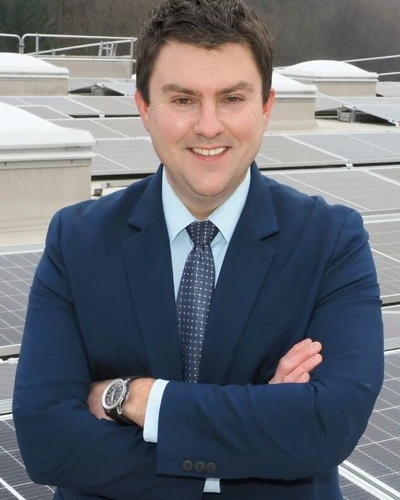
Alexander Wimmer
Head of Technology and Sustainability Aluminium Division
Constantia Flexibles
Master in Material Sciences (University of Leoben)
MBA in Generic Management
PhD in Material Sciences (Max Planck Institute Düsseldorf)
2014 to 2022 Head of R&D Neuman Aluminium
since 2022 Head of Technology and Sustainability Constantia Flexibles Aluminium Division
Participates in
TECHNICAL PROGRAMME | Energy Leadership
Financing the Future Energy Supply
Forum 27 | Technical Programme Hall 5
28
April
10:00
11:30
UTC+3
The financial landscape of energy supply in Europe is undergoing a profound transformation. Historically, energy prices—particularly for gas—played a relatively minor role in industrial decision-making. For decades, natural gas was consistently three to four times cheaper than electricity, making it the default choice for thermal processes across the continent. Additionally, the rapid expansion of renewable electricity infrastructure has led to a significant rise in grid-related costs, which are increasing by 5–10% annually. Simultaneously, European companies are accelerating their electrification efforts to meet ambitious net-zero targets, creating a complex tension between sustainability goals and economic competitiveness.
This paper explores the financial implications of various decarbonization strategies for industrial energy consumers. It presents a comparative analysis of capital expenditure (capex), operational expenditure (opex), and carbon reduction potential across different technological pathways. These are evaluated in the context of current and projected emissions trading costs, which are becoming an increasingly influential factor in strategic energy planning.
The findings reveal that while electrification may offer environmental benefits, it is often economically viable only for niche applications. For many industrial processes, particularly those requiring high-temperature heat, natural gas remains indispensable. However, to align with climate targets, the use of methane must be decarbonized. This can be achieved through the usage of bio-methane, blending of natural gas with bio-methane or hydrogen, or carbon capture and storage (CCS) technologies.
By quantifying the trade-offs between sustainability and cost, this paper provides a framework for making financially sound decisions in the transition to a low-carbon energy supply. It highlights the need for targeted investment, policy support, and innovation to ensure that decarbonization does not come at the expense of industrial competitiveness. Ultimately, financing the future energy supply requires a nuanced approach that balances environmental responsibility with economic resilience.
This paper explores the financial implications of various decarbonization strategies for industrial energy consumers. It presents a comparative analysis of capital expenditure (capex), operational expenditure (opex), and carbon reduction potential across different technological pathways. These are evaluated in the context of current and projected emissions trading costs, which are becoming an increasingly influential factor in strategic energy planning.
The findings reveal that while electrification may offer environmental benefits, it is often economically viable only for niche applications. For many industrial processes, particularly those requiring high-temperature heat, natural gas remains indispensable. However, to align with climate targets, the use of methane must be decarbonized. This can be achieved through the usage of bio-methane, blending of natural gas with bio-methane or hydrogen, or carbon capture and storage (CCS) technologies.
By quantifying the trade-offs between sustainability and cost, this paper provides a framework for making financially sound decisions in the transition to a low-carbon energy supply. It highlights the need for targeted investment, policy support, and innovation to ensure that decarbonization does not come at the expense of industrial competitiveness. Ultimately, financing the future energy supply requires a nuanced approach that balances environmental responsibility with economic resilience.
