


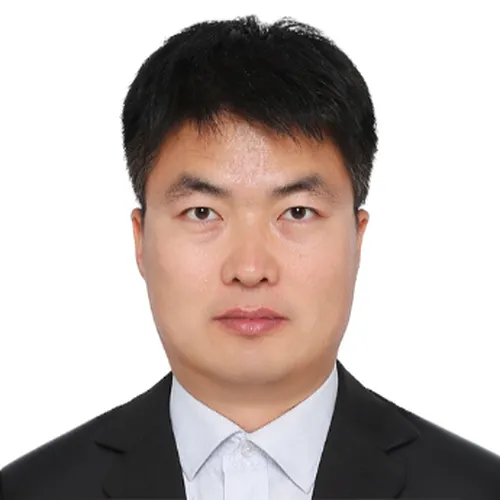
Lidong Mi

Senior Engineer

Sinopec Petroleum Exploration and Production Research Institute

Lidong Mi, born in 1987 and a senior engineer, graduated with a PhD from China University of Petroleum (Beijing) in 2017. He visited Texas A&M University in the United States and currently works at the Sinopec Petroleum Exploration and Development Research Institute. He is mainly engaged in natural gas development, UGS site selection, design, operation tracking, intelligent construction, and research on the application of big data in oil and gas field development. He is responsible for 2 national projects and 12 provincial and ministerial projects. Served as a review expert for the National Natural Science Foundation of China, as well as a member of the editorial board/editorial board and reviewer for well-known domestic and foreign journals such as "Journal of Petroleum", "Natural Gas Industry", "Petroleum Science Bulletin", and "Natural Gas Industry B". Received multiple provincial and municipal level scientific and technological progress awards and plan planning awards, published more than 60 papers, applied for 15 patents, applied for 8 software copyrights, and 1 standard.

Participates in

TECHNICAL PROGRAMME | Primary Energy Supply

New Exploration & Production Technologies to Extend Supply
Forum 03 | Digital Poster Plaza 1
29
April
11:30 13:30
UTC+3
 This research focuses on co-optimizing natural gas storage and enhanced oil recovery in depleted gas condensate reservoirs (DGCR), which are ideal for subsurface storage sites due to their validated seal integrity. DGCRs often face challenges like pressure depletion and condensate banking, decreasing near-well permeability, and hydrocarbon recovery. The study aims to efficiently convert these reservoirs into gas storage sites, balancing market demand and improving recovery of both condensate gas and oil, thus enhancing economic viability. We develop a reservoir simulation model for converting DGCR into natural gas storage tank. During low-demand seasons (e.g., summer), natural gas is injected to restore pressure and re-vaporize condensate oil and then produced with the condensate oil during high-demand seasons (e.g., winter) to meet market demand. We further develop machine learning-based surrogate models to emulate reservoir simulation by covering a wide range of operational parameters such as well spacing, well perforation, injection and production durations, and well schedules. These models are integrated into an optimization workflow to maximize the recovery of condensate oil and condensate gas by optimizing these operational parameters. Conclusions: We successfully implemented the AI-based optimization strategy in BZ condensate gas reservoir, known for its effective interlayer sealing. Our advanced AI-based surrogate models, with a 97% accuracy, adeptly predict oil and gas recovery, considering input factors like well spacing, perforation, the duration of injection and production, and well schedules. The conversion of the BZ block into a gas storage facility was achieved by running AI-based optimization. The optimization resulted in a significant 10% increase in condensate oil recovery and a 5% rise in condensate gas recovery. Through this process, we determined optimal periods for injection (210 days) and production (150 days). Notably, we also observed considerable alleviation of the condensate banking effect near the wellbore, which substantially enhanced condensate oil productivity. This study introduces a novel method in gas storage reservoir management by transforming depleted condensate gas reservoirs into economically efficient gas storage facilities. This innovative approach, which outperforms traditional methods and conversions of dry gas reservoirs, offers dual advantages of peak regulation and enhanced oil recovery. This advancement presents a cost-effective solution for condensate gas reservoir management, representing a significant leap in reservoir engineering and practices.