


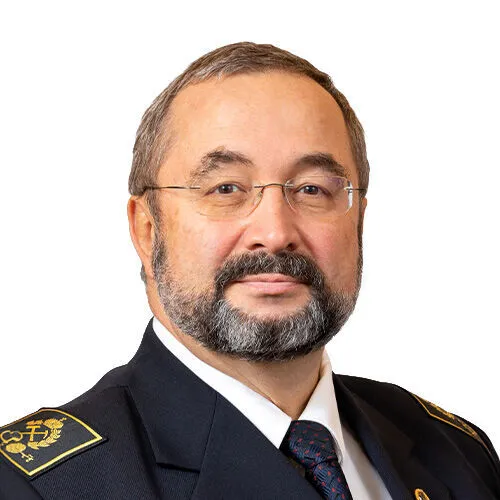
Roman Samsonov
Research Lead of the Youth Laboratory "Organizational and Technological Systems for Using Artificial Intelligence in Construction"
Moscow State Construction University
Russia
Roman Samsonov graduated from the Grozny Petroleum Institute with a degree in Mechanical Engineering with a focus on oil and gas in 1983. In 2005, Roman was offered the position of CEO (General Director) of Gazprom VNIIGAZ, which has been developing scientific cooperation in natural gas and gas technologies research at the Institute with leading specialized R&D organizations and institutions of the Russian Academy of Sciences. He has represented the company in the Working Committees of the International Gas Union for many years. From 2007 to 2009, he was also closely involved in the development and publication of the special report on “Prospects of the world gas industry until 2030” by the International Gas Union. For more than 20 years, Roman has taken part in the UNECE Committee on Sustainable Energy (Geneva). In 2015, he did a great preparation job as the Chairman of the sectoral initiative SIPS “Security of pipelines” (http://www.unece.org/trade/wp6/sectoralinitiatives/pipelinesafety/sips.html) of working group 6 of Trade in ECE UN, Geneva. As part of the initiative, a working group was created to conduct a unique study and then develop recommendations for regulating safety issues during the transportation of hydrogen and hydrogen mixtures via pipelines. The results of this group's work are planned to be presented at the congress. Roman is the co-chair of this working group.
Currently, he is actively involved in academic and educational programs, being a professor and Scientific Head of Research Laboratory at the Moscow State University of Civil Engineering and an associate professor at the Graduate School of Public Administration of the Lomonosov Moscow State University. He has been a Professor of the Gas technologies and Underground Gas Storages Department in the Gubkin Russian National Oil and Gas University for more than 17 years. Part of his research interests is related to hydrogen and its transportation and storage.
Roman is the author of ten books and co-author of more than 200 scientific articles, as well as being a co-author of thirty patents in Russia. He is a Doctor of Technical Science, Master of Business Administration, Professor of MGSU, and Academic Member of the Russian Academy of Natural Sciences.
E-mail: [email protected], +79857636368
Participates in
TECHNICAL PROGRAMME | Energy Infrastructure
The purpose of the recommendations is to reduce technical barriers to trade and facilitate access to international markets. The document is based on Recommendation L of the UNECE WP 6 and is structured according to the general regulatory framework.
The general regulatory framework includes four main sections:
Scope of Application – defines the range of products or services to which it is applied.
Product Requirements – identifies the main problems in the field of safety, health, and the environment, specifies the main requirements, and makes references to relevant international standards or norms, includes:
- a description of the properties of hydrogen and the need to take them into account when regulating products;
- material compatibility and design factors;
- explosion protection and fire safety requirements.
Product Conformity – describes ways to demonstrate compliance, including possible methods such as supplier declaration, third-party certification, or inspection. As part of the conformity assessment of hydrogen pipelines, not only should pipeline equipment be considered, but also organizations involved in its design, manufacture, installation, operation, maintenance, and repairs, including the qualifications of the relevant personnel.
Market Surveillance – describes the mechanisms for ensuring continued compliance, including the conditions under which restrictions may be imposed on a product or it may be withdrawn from the market. The key principles of market surveillance in the context of hydrogen transportation and storage are compliance with regulations, i.e., if possible, oversight mechanisms should be brought into line with recognized international standards.
The final version of the document contains references to ISO and IEC standards, and in addition to API standards, ISO and IEC standards are indicated as alternatives, which significantly reduces the influence of the American Petroleum Institute.
Considering that fact, the essence of the recommendations is to serve as a model for developing legislation in countries where regulations for pipeline infrastructure for hydrogen transportation are currently lacking and to help bring existing national standards into line with internationally harmonized best practices. The UNECE recognizes ISO standards as the leading best practice, not API. This approach allows experts from all countries to participate in the development of advanced standards.
A significant achievement of the working group is the creation documents related to the transportation of hydrogen through main pipelines operating in China, Australia, the United States, and the European Union, as well as the identification of the main ISO standards on this topic. The results of the analysis are contained in the Appendix to the Recommendations. The recommendations were approved in September 2025 during the Standardization Forum organized by the UNECE WP 6, and are officially published.
Co-author/s:
Darya Michurina, Senior Expert of Committee on Technical Regulation, Russian Union of Industrialists and Enterpreneures.
Aleksej Samsonov, Research Associate, Youth Laboratory, Moscow State University of Civil Engineering.