


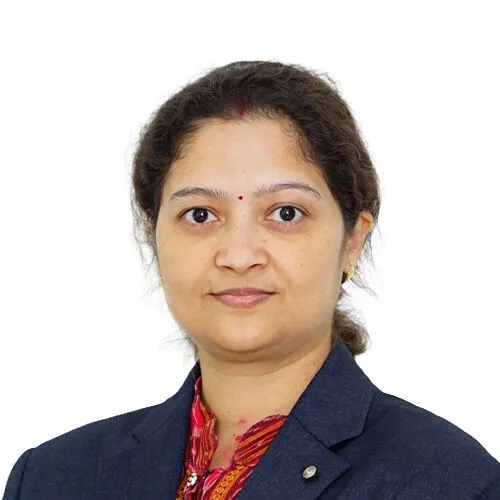
Bharati Panigrahy
Senior Scientist
HP Green R&D Center, Hindustan Petroleum Corporation Limited (HPCL), Bangalore, India
India
Dr. Bharati Panigrahy is a Senior Research Scientist at Hindustan Petroleum Corporation Limited (HPCL), having more than 15 years of research experience in renewable energy and green hydrogen production technologies. She is a recipient of several prestigious awards, likes top 50 Women achiever in Science Technology Engineering & Mathematics (STEM) by Confederation of Indian Industry (CII) and Best Innovation in R&D by Govt. of India. Dr. Bharati completed her Ph.D. from IIT Bombay, by claiming Best PhD Thesis Award for her work in IIT Bombay. She has developed patented prototype Electrolyzer Technology of kilowatt capacity for Green hydrogen production at HPCL for which she begs Best Innovation in R&D Award from CHT, Ministry of Petroleum & Natural Gas (MoPNG), Govt. of India. Dr. Bharati has 24 published international journals and granted patents to her name, primarily focusing in the area of hydrogen and energy materials, with many more in pipeline. With her vast research experience in both academics (being a faculty from Indian Institute Science Bangalore) and industries, she brings in implementable solutions in Hydrogen production and storage technologies.
Participates in
TECHNICAL PROGRAMME | Energy Fuels and Molecules
Here, first time we report the hybrid nanocomposite of Iron and Nickel phosphides based electrocatalyst directly grown on metal foam as an integrated electrode by a simple facile one step phosphidation process giving rise to highly crystalline composite with predominantly exposed [121] facets of nickel phosphide and [211] facets of iron phosphide, which accounts for the high electrocatalytic activities. The performance of metal phosphide towards hydrogen and oxygen evolution was examined under application relevant conditions in an anion exchange membrane electrolyzer and Alkaline electrolyzer cell stack. The formulated electrocatalyst outperforms other precious and non-precious electrodes operated at similar operating conditions. Evaluation of the in-house developed electrocatalyst in the prototype in-house design electrolyzer stack is conducted, and the efficiency of the electrolyzers are better, with the electrocatalyst cost is significantly cheaper compare to the commercial one.
We have observed 14% less energy consumption compares to the commercial electrodes. We have achieved the increased efficiency by limiting 27% heat loss compare to commercial minimum of 50% by controlling the activation loss. We have carried out the mass balance and achieved close to 100% Faradic efficiency by minimizing the ohmic loss. Mass loss is also controlled by tuning the electron modulation followed by work function. By using the in-house developed electrode materials and technologies, we have successfully demonstrated prototype 1 kW alkaline and anion exchange membrane (AEM) electrolyzer cell stack module. We have evaluated the prototype 1 to 10 kW alkaline and AEM electrolyzers for more than 6 months to analyze the stability study. We have successfully established the increase in overpotential is less than 0.021 V with a constant current density of 0.6-1.1 A/cm2. The stability test is carried out with a potential range from 1.8 to 2.4 Volt and current density range of 0.1 to 1 A/cm2. For each case it is stable for more than 2000 hours. The in-house designed stacked electrolyzer exhibited stable performances with a hydrogen production rate of few Nm3 per hour without any decay, pave the path towards large scale application with 35% reduction in CAPEX and OPEX cost.