

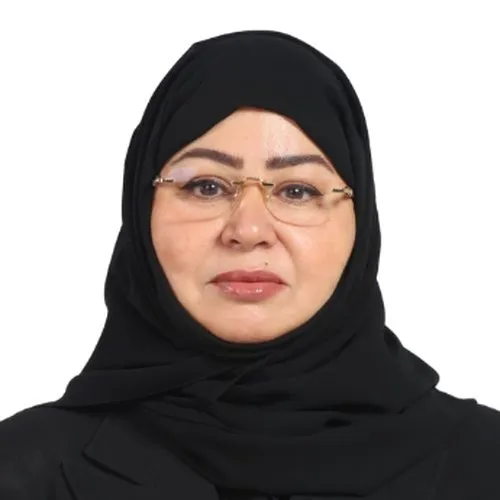
Ibtesam Badhrees
Chief Researcher, Nuclear Technology Institute
Nuclear Technology Institute, King Abdulaziz City for Science and Technology (KACST)
Saudi Arabia
She is a pioneering Saudi physicist and Chief Researcher at KACST. She is the first Saudi and Gulf woman to join CERN as a researcher and holds PhDs in Particle Physics and International Relations. Her research spans high-energy physics, neutrino interactions, and nuclear appl., alongside leadership roles in science diplomacy and institutional excellence. Recognized globally, she was named “Woman Physicist of the Month” by the APS, regarded as one of the distinguished Saudi women in science with highest Sci. Paper citation at KACST.
Participates in
TECHNICAL PROGRAMME | Energy Leadership
Human Capital - Attracting, Training and Retaining
Forum 30 | Hall 5 Digital Poster Plaza 5
30
April
10:00
12:00
UTC+3
All around the world, women hold a small percentage of leadership positions in STEM fields,
but women represent 28.2% of STEM jobs versus 47.3% in other sectors, in industries around
46% at all levels, but 25% at the C-suite level.
Talking about researchers, we can see an increase in the participation of women in this field, but
they still represent 29.3% in 2019!
Across the Middle East, women hold 3% of executive roles compared to 7% globally, especially
at senior and executive levels.
In Arab countries, especially Egypt, Saudi Arabia, and the UAE, women comprise 6.8% -10% of
senior managers. In KSA, women hold just 8% while men occupy 92%, and in the UAE,
women-led teams are targeting gender balance. In general, in Arab countries, the representation
of females in the Energy sector in the C-suite remains well below the global average.
Today, the Kingdom of Saudi Arabia witnesses a great era of transformation in many sectors.
One important sector is Energy, where Vision 2030 of the Kingdom supports this fruitful change
toward a renewable and sustainable energy future. It empowers women in the energy sector to
participate in the industries of research, development, and innovation.
Saudi Women are at the center stage in the Energy sector, participating in transforming energy
sources, implementing new projects for clean energy, and leading initiatives to localize new
technologies, driving transformation in the energy sector that extends beyond technology to
include social and cultural progress. In 2023, female labor force participation in Saudi Arabia
reached approximately 34-35%, according to governmental and World Bank sources. The overall
rate stood close to 35% in early 2024.
While women are increasingly present in the scientific workforce in Saudi Arabia, their
representation in leadership roles remains disproportionately low. Yet, visionary women past and
present continue to inspire, break records, and reshape the scientific landscape.
In this paper, I will discuss the challenges and future opportunities for women in the Saudi
Arabian energy ecosystem by highlighting various initiatives and collaborations at both local and
international levels. As this paper shows the history and future of women in the energy sector,
it’s a call for continued investment in women-led innovation to secure a more sustainable and
inclusive energy future for the Kingdom of Saudi Arabia and globally.
but women represent 28.2% of STEM jobs versus 47.3% in other sectors, in industries around
46% at all levels, but 25% at the C-suite level.
Talking about researchers, we can see an increase in the participation of women in this field, but
they still represent 29.3% in 2019!
Across the Middle East, women hold 3% of executive roles compared to 7% globally, especially
at senior and executive levels.
In Arab countries, especially Egypt, Saudi Arabia, and the UAE, women comprise 6.8% -10% of
senior managers. In KSA, women hold just 8% while men occupy 92%, and in the UAE,
women-led teams are targeting gender balance. In general, in Arab countries, the representation
of females in the Energy sector in the C-suite remains well below the global average.
Today, the Kingdom of Saudi Arabia witnesses a great era of transformation in many sectors.
One important sector is Energy, where Vision 2030 of the Kingdom supports this fruitful change
toward a renewable and sustainable energy future. It empowers women in the energy sector to
participate in the industries of research, development, and innovation.
Saudi Women are at the center stage in the Energy sector, participating in transforming energy
sources, implementing new projects for clean energy, and leading initiatives to localize new
technologies, driving transformation in the energy sector that extends beyond technology to
include social and cultural progress. In 2023, female labor force participation in Saudi Arabia
reached approximately 34-35%, according to governmental and World Bank sources. The overall
rate stood close to 35% in early 2024.
While women are increasingly present in the scientific workforce in Saudi Arabia, their
representation in leadership roles remains disproportionately low. Yet, visionary women past and
present continue to inspire, break records, and reshape the scientific landscape.
In this paper, I will discuss the challenges and future opportunities for women in the Saudi
Arabian energy ecosystem by highlighting various initiatives and collaborations at both local and
international levels. As this paper shows the history and future of women in the energy sector,
it’s a call for continued investment in women-led innovation to secure a more sustainable and
inclusive energy future for the Kingdom of Saudi Arabia and globally.