


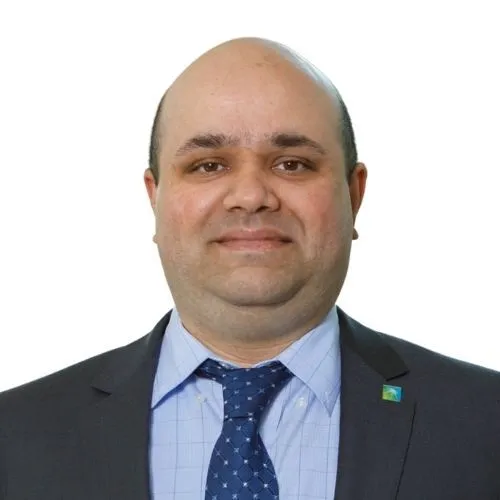
Rajesh Goteti
Geological Resources Team Lead
Aramco Americas
India
Rajesh Goteti joined Aramco Americas R&D in 2014 and his primary area of expertise is Structural Geology and Geomechanics. Since joining Aramco, he worked in diverse areas including natural fracture prediction, salt tectonics, geomechanical forward modeling and regional in-situ stress prediction. He previously worked at the ExxonMobil Upstream Research Company (2012 – 2014). Rajesh serves on the Editorial Board of several reputed Geoscience journals and is the Lead Editor on the Geological Society of London Special Publication Book on state-of-the-art in regional stress characterization and prediction. He currently leads the Geological Resources Team in the Houston Research Center and is overseeing a geoscience technology portfolio that supports recovery, discovery of hydrocarbons and several emerging initiatives in sustainability and strategic resources.
Participates in
TECHNICAL PROGRAMME | Energy Infrastructure
Traditionally, hydrogen is stored in salt caverns by injecting compressed gas into the void space. Here we introduce a novel approach to enhance hydrogen storage capacity by filling caverns with microporous sorbent materials prior to gas injection. A range of microporous sorbents—including activated carbons and metal-organic frameworks—were evaluated under representative pressure-temperature conditions. Among them, activated carbon may be the most scalable and cost-effective option for field deployment. The use of commercially available sorbents with favorable cost-performance ratios makes this approach applicable to both existing caverns and new constructions.
Our experimental results show that microporous materials can significantly increase volumetric hydrogen storage, especially under shallow cavern conditions where gas compression is less effective. When filled with microporous activated carbon, for example, hydrogen storage capacity can be increased by up to 15% when compared to empty caverns. This enhancement offers both economic and operational benefits by maximizing the working gas volume per cavern and reducing capital and operational costs. Additionally, sorbents may provide extra mechanical support, potentially lowering the minimum operational pressure and improving cavern stability during cyclic injection and withdrawal.
This approach represents the first known application of microporous sorbents for enhancing hydrogen storage in engineered salt caverns. It bridges the gap between surface-based hydrogen storage technologies and subsurface geological storage systems. Future research will focus on searching more cost-effective sorbent materials, optimizing the performance of existing sorbents under specific geological settings, evaluating long-term performance under cyclic loading, and conducting field-scale demonstrations to validate the concept.
Co-author/s:
Rajesh Goteti, Geological resources Team Lead, Aramco Americas.
Ahmet Atilgan, Research Scientist, Aramco Americas.
Dr. Yaser Zayer, Lead Geologist, Saudi Aramco.