

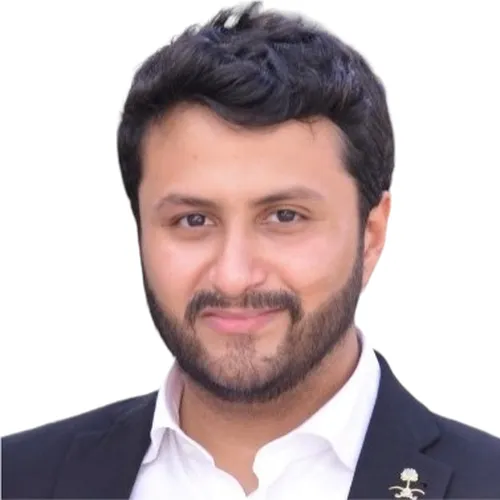
Ahmed AlJameel
Energy & Climate Policy Researcher
Centre for Environmental Policy, Imperial College London
Saudi Arabia
Ahmed is a PhD student and a researcher in energy & climate policy at the Centre for Environmental Policy (CEP) at Imperial College London. His research focuses on the climate policy design towards achieving net-zero energy transition in Saudi Arabia. He is also a nominated expert in the United Nations Framework Convention on Climate Change (UNFCCC) Roster of Experts. Ahmed is a member of Gulf Committee and Policy Council at Rihla Initiative for Green Economic Growth. Previously, Ahmed worked in the Ministry of Energy of Saudi Arabia at the Sustainability & Climate Change deputyship. He has participated in the UN climate negotiations as a lead negotiator for Arab Group in COP26 and COP27 in climate finance agenda items.
Participates in
TECHNICAL PROGRAMME | Energy Fuels and Molecules
For instance, e-kerosene which is a power-to liquid (PtL) sustainable aviation fuel is currently 5 times more expensive than conventional kerosene fuel. If the carbon source of the synthetic PtL fuel is from negative emissions using Direct-Air Capture (DAC), this price gap increases further up to 6 times more expensive than the current price of conventional fuel. Although that the current price of the biomass-based SAF is just around 3 times, however there are resource availability limitation especially in the arid and semi-arid regions, which give rise to energy security issues when these feedstocks are imported from somewhere else. LCAF which is a fossil-based clean aviation fuel exhibits the smallest price difference due to the fact that its price is calculated based on adding a premium equal the abatement cost. However, LCAF only reduce 10% of the lifecycle emissions of the aviation fuel, unlike other SAFs which reach 50-70% reduction.
The Kingdom of Saudi Arabia (KSA) holds a strategic position in global aviation to serve as a connection hub between Europe, Asia, and Africa, while also managing a rapidly growing domestic and international air travel market. As part of KSA Vision 2030, the country aims to transform its aviation sector by tripling its capacity while maintaining environmental sustainability. A major milestone in this effort is the development of Red Sea Airport, which is set to become the first carbon-neutral airport in the region, with Fly Red Sea fuelled exclusively with SAF and LCAF. Despite these opportunities, the sector still relies almost entirely on conventional jet fuels with the absence of any policy incentives to support alternative fuels.
This research proposes a novel design of market-based mechanisms (MBMs) to accelerate the uptake of alternative drop-in fuels in KSA aviation sector. In addition, a novel agent-based model (ABM) was developed to simulate the diffusion pathways for these alternative drop-in fuels under different MBM scenarios in KSA air fleet. The study provides insights on the optimal intervention mixes to accelerate decarbonisation in KSA aviation sector.
Co-author/s:
Gbemi Oluleye, Assistant Professor, Centre for Environmental Policy, Imperial College London.