


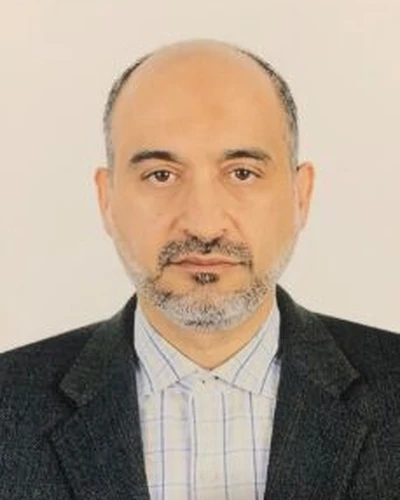
Feras Hamad
Research Science Consultant
Aramco
Feras holds a Ph.D. in Chemical Engineering, specializing in gas separation membranes. Feras served in several companies with total experience over 25 years, from which 17 years at Saudi Aramco Gas and Liquid Treatment Division - R&DC. He has played a pivotal role in evaluating, developing, and deploying membrane-based technologies for applications such as CO₂ capture, natural gas upgrading, and sulfur emissions control—improving process efficiency and supporting national sustainability objectives of the Kingdom. He is the inventor/co-inventor on 17 granted patents assigned to Aramco. Feras has authored/co-authored over 26 peer-reviewed papers.
Participates in
TECHNICAL PROGRAMME | Energy Technologies
GHG Emissions (Scope 1&2) Abatement (CO2, Methane) - Detection; CO2 Capture; CCUS; DAC; Carbon Products
Forum 20 | Technical Programme Hall 4
28
April
10:00
11:30
UTC+3
A novel membrane-based process enables the simultaneous reduction of SO₂ emissions and CO₂ capture from sulfur recovery unit (SRU) tail gas streams.
During acid gas removal from natural gas—whether to meet pipeline specifications or for further processing such as liquid recovery or nitrogen removal—CO₂ is captured alongside H₂S and sent to the Claus unit. Within the Claus unit, H₂S is converted into elemental sulfur for safe disposal. However, CO₂ is typically released into the atmosphere via the thermal oxidizer downstream of the Claus tail gas treatment unit. H2S-selective amines tail gas treatment unit (TGTU) is deployed downstream of the SRU to assure compliance with sulfur emission specs in the stack. While post-combustion CO₂ capture technologies, such as amine-based systems, can be employed downstream of the TGTU. Amine-based technologies are bulky and energy-intensive due to operation at near-atmospheric conditions.
Saudi Aramco has patented a new membrane-based process that simultaneously achieves both efficient H₂S removal from tail gas and CO₂ capture. This process utilizes special commercially available membranes: H2S-selective membranes, and CO2-selective membranes, hence it is referred to as Membrane Tail Gas Treatment (MTGT) process.
The hydrogenation and quench tower sections remain similar to those found in conventional amine-based tail gas treatment systems. However, the innovation begins downstream of the quench tower, where the tail gas stream is compressed to 15 bar and directed to MTGT, where its configuration of H₂S- and CO₂-selective membranes is optimized with the required compression to:
By integrating the tail gas treatment with CO₂ capture, the required compression step is optimized, providing a cost-effective solution for both processes.
Potential applications of this technology will be presented.
During acid gas removal from natural gas—whether to meet pipeline specifications or for further processing such as liquid recovery or nitrogen removal—CO₂ is captured alongside H₂S and sent to the Claus unit. Within the Claus unit, H₂S is converted into elemental sulfur for safe disposal. However, CO₂ is typically released into the atmosphere via the thermal oxidizer downstream of the Claus tail gas treatment unit. H2S-selective amines tail gas treatment unit (TGTU) is deployed downstream of the SRU to assure compliance with sulfur emission specs in the stack. While post-combustion CO₂ capture technologies, such as amine-based systems, can be employed downstream of the TGTU. Amine-based technologies are bulky and energy-intensive due to operation at near-atmospheric conditions.
Saudi Aramco has patented a new membrane-based process that simultaneously achieves both efficient H₂S removal from tail gas and CO₂ capture. This process utilizes special commercially available membranes: H2S-selective membranes, and CO2-selective membranes, hence it is referred to as Membrane Tail Gas Treatment (MTGT) process.
The hydrogenation and quench tower sections remain similar to those found in conventional amine-based tail gas treatment systems. However, the innovation begins downstream of the quench tower, where the tail gas stream is compressed to 15 bar and directed to MTGT, where its configuration of H₂S- and CO₂-selective membranes is optimized with the required compression to:
- Reject nitrogen with acceptable H2S content to meet the SO2 spec in the stack.
- Separate H₂S rich stream that is recycled to the furnace reactor or upstream of the preheater of the first catalytic converter, depending on the Claus unit operation and quality of its feedstock.
- Capture CO₂ with minimal contaminants, ensuring H₂S remains below 200 ppm for safety and corrosion control, and nitrogen stays below 2% to avoid phase envelope issues in case CO₂ is reinjected into saline aquifers.
By integrating the tail gas treatment with CO₂ capture, the required compression step is optimized, providing a cost-effective solution for both processes.
Potential applications of this technology will be presented.
